If you are preparing for the ARRT CT exam, September 1, 2026 was a meaningful date. That is when the American Registry of Radiologic Technologists (ARRT) implemented updated Computed Tomography examination content specifications—the outline that tells candidates what the registry exam covers and how scored questions are distributed.
Whether you are cross-training into CT, finishing structured education, or refreshing for CQR, understanding these updates helps you study with purpose instead of guessing what “might” be on the test.
What Changed in the ARRT CT Content Specifications?
ARRT’s Examination Content Specifications for Computed Tomography were board-approved in July 2025 and carry an implementation date of September 1, 2026. The document explains that the exam assesses knowledge and cognitive skills typically required for entry-level CT practice, based on a national practice analysis and the CT Task Inventory.
Source: ARRT Examination Content Specifications and the CT content specifications PDF (implementation date September 1, 2026).
How many questions are on the CT exam?
According to the current CT content specifications, the examination includes 165 scored questions plus 30 unscored (pilot) questions. Scored items are organized into four major content categories:
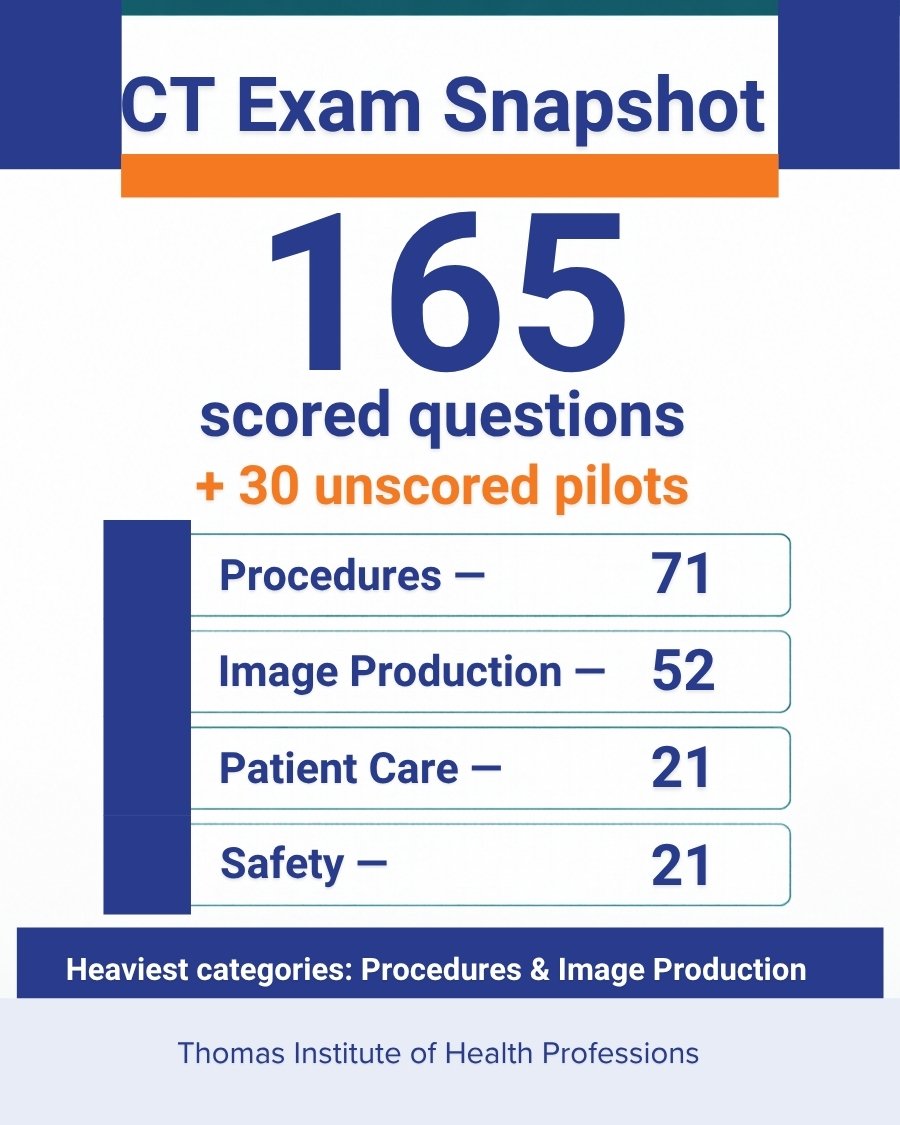
- Patient Care — 21 scored questions (Patient Interactions and Management)
- Safety — 21 scored questions (Radiation Safety and Dose)
- Image Production — 52 scored questions (Image Formation; Image Evaluation and Archiving)
- Procedures — 71 scored questions (Head, Spine, and Musculoskeletal; Neck and Chest; Abdomen and Pelvis)
ARRT also notes that SI units are the primary units of radiation measurement used on the CT examination—an important detail for dose-related study.
Clinical Experience Requirements Updated Too
Content specifications are only part of the picture. On May 29, 2026, ARRT published an update explaining that revised CT clinical experience requirements also took effect on September 1, 2026.
ARRT summarized several major clinical-document changes, including:
- Extremity trauma replaced musculoskeletal trauma
- Larynx/airway without contrast was added
- Mandatory IV contrast was added to soft tissue neck
- Esophagram with oral contrast was added
- Colonography (“virtual”) was added
- Surgical planning was added
- Pediatric (12 and under) was changed to infant/young child (6 and under)
- Ablations was removed
- X-ray tube warmup was added to calibration checks
Source: Updated Computed Tomography (CT) Clinical Experience Requirements Document (ARRT News, May 29, 2026).
If you are documenting clinical experience for post-primary CT certification, review the current clinical requirements on your ARRT account and on arrt.org rather than relying on older checklists.
Practical Study Tips Aligned to the New Outline
1. Weight your study time to Procedures and Image Production
Together, Procedures (71) and Image Production (52) account for most of the scored exam. Build a weekly plan that spends more time on protocol reasoning, cross-sectional anatomy, reconstruction choices, artifact recognition, and dose-related parameter trade-offs—not only flashcards for rare facts.
2. Practice “why this scan” decision-making
Many CT registry questions reward clinical judgment: contrast indications and contraindications, timing bolus versus bolus tracking, pediatric versus adult considerations, and when multiphase liver, pancreas, adrenal, or renal protocols apply. Talk through cases out loud. Explain why a CTA chest for PE differs from a low-dose lung screening study.
3. Treat Safety as a daily skill, not a last-minute chapter
Radiation Safety and Dose is its own scored category. Be fluent with CTDI, DLP, dose modulation concepts, pitch, collimation/beam width, and strategies that minimize patient exposure while maintaining diagnostic quality. Use SI units (mGy, mSv) as your default language.
4. Use ARRT’s official documents as your study map
Download the current CT Examination Content Specifications and Task Inventory from ARRT. Then map each study session to a subcategory. If a review book or recorded lecture does not clearly connect to the outline, deprioritize it.
Also New: Easier Self-Service for CQR Full CE Prescription
While CT candidates focus on registry prep, many credentialed R.T.s are simultaneously navigating Continuing Qualifications Requirements (CQR). ARRT recently streamlined a key step: if you decide to opt out of the Structured Self-Assessment (SSA) and accept the full Continuing Education (CE) prescription, you can now make that selection in your ARRT account without calling the call center.
Source: New Online Option Makes It Easier to Choose SSA or Full CE Prescription (ARRT R.T. Update).
ARRT still notes elsewhere that taking the SSA may help you identify targeted learning needs, and that accepting the full prescription can mean completing more CE. Start early in your three-year CQR window so you have time to finish prescribed activities. Learn more on ARRT’s CQR overview page.
How The Thomas Institute of Health Professions Can Help
At The Thomas Institute of Health Professions, our courses are designed for working imaging professionals who need clear instruction, flexible access, and ARRT-/ASRT-accredited credit pathways. We emphasize live, instructor-led teaching so you can ask questions in real time—not just watch another recording alone.
Upcoming “Live” CT Webinar Series (4-day weekends)
Our next “Live” CT Webinar Series – 4-day (Weekend) meets November 28–29 and December 5–6, 2026 (Arizona time, 8:00–11:45 a.m.). The course is priced at $355 and is approved for structured education, continuing education, and continuous quality review credits. Sessions are 3 hours and 45 minutes each—ideal if you need focused CT review after the September 2026 content-spec changes.
Browse CT and related pathways
- Explore all online CT courses
- Compare options on our homepage course overview
- If MRI is next for you, see the 10-Week Online MRI Program – with Clinic Option (next cohort December 7, 2026–February 22, 2027, $1,800)
- Radiographers preparing for review or reinstatement can also look at our radiography courses, including the Radiography Review Series – 5 Sessions Self Study ($275; register anytime)
For more background on CQR itself, see our earlier guides: ARRT CQR Requirements: What They Are and What They’re Not and ARRT Continuing Qualifications Requirements (CQR) for Radiologic Technologists.
Quick Checklist Before You Sit for CT
- Confirm you are studying from the post–September 1, 2026 CT content specifications
- Align clinical documentation with the updated CT clinical experience requirements
- Complete your structured education (minimum 16 hours) within ARRT’s required timeframe before applying
- Build a study plan weighted toward Procedures and Image Production
- If CQR is open in your account, decide early whether to take the SSA or accept the full CE prescription through ARRT’s self-service option
Ready for Focused, Live CT Prep?
Registry success starts with knowing what ARRT actually tests—and then practicing those skills with an instructor who can explain the “why.” Join our upcoming Live CT Webinar Series for November 28–December 6, 2026, or browse all CT courses at The Thomas Institute of Health Professions.
Questions? Call (480) 360-2661 or email info@thomashealthprofessions.com (Monday–Friday, 9:00–5:00).